DAY 3 – 1st Clinic, San Pedro Guamote.
by Sunita Kheterpal
When I awoke this morning, it was quite cloudy. Our room, which I share with another McGill student, Shruti, has a balcony (I think one of the only rooms with this beautiful balcony). It overlooks the road in front and we wake up to taxis honking (but it’s okay because you have to wake up early anyways). The train station is right across our room (no trains run because this part of the track is broken). The showers are hot (don’t worry about running water). I made sure that after yesterday’s piercing cold shower, none of us had to go through that again! The only problem is that I’m not sure how to get the cold water back in…I’ll figure it out eventually.
The breakfast venue is across the street and the Señor and Señora who own the restaurant are extremely welcoming. Señora is a doting mother who tells us to drink the leche (hot milk). She often sings “leche, leche, leche” and dances with the steaming hot milk in one hand and tea in the other. She reminds me of my mom who constantly tells me to drink milk to prevent my bones from cracking all the time. On the bright side the milk is very different from Canadian and American milk but in a good way. The Señora and Señor make amazing juice (blackberry which you would never think was blackberry and juice from special Ecuadorian tomatoes which tastes like mango/peach/orange). Also, don’t worry the couple is extremely accommodating for those vegetarians out there!
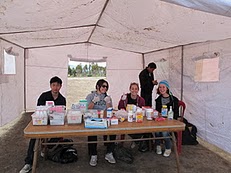
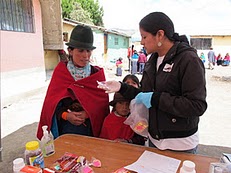
We boarded the bus at 7 am and drove for 1.5 hr to our destination, San Pedro Guamote. It is a little town that lies high in the Andes Mountains. It is one of the poorest towns in all of Ecuador. In the bus, we were split into groups (vitals, education, medicine, dentistry, gynecology, pharmacy and our week’s project to build a baño for this community).
- I was in a group of five, taking vital signs.
- Following patient inscription our group measured height, weight, blood pressure, and temperature. I was mostly taking blood pressure and ensuring that everybody (patients and volunteers) were okay.
- Once the vitals were “terminado”, I told the patients to “sigueme por favor a la carpa educacion”.
I learned Español in Grade 9 (quite a long time ago), and since then have never used any Spanish. This was the first time in a foreign country that I actually tested out this new language. I grew up in Montreal and I find that Español is very similar to French. You can add an “o, a, or e” at the end of a French word and it becomes Español. It turns out that I had the phrases down but when I pronounced them, they weren’t quite the same. Instead of saying “sit here”, I said “feel here”. It was amusing because the patients would laugh at us, but some of them helped me pronounce the sentences or corrected my grammar.
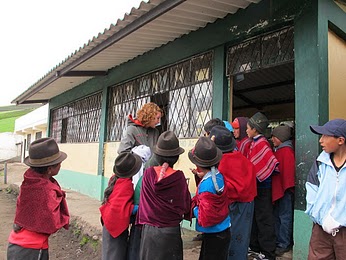
There were many young mothers, so I was also holding the little babies (one was a couple of days old and another was a few months old). The children were extremely well behaved, quiet, but curious. They intently watched us foreigners roll in on our touristy bus and set up our tents. Then, when we tried to talk to them, they would smile, look away shyly, and finally run away. When they realized we were here to help them, I think they warmed up to us. I actually started getting responses when I asked “coma te llamas”! We did not have many patients (about 50) and thus we ended early. Most of the patients were women and children.
The poverty here is a different type of poverty than I have ever experienced before. I don’t know why but since the day that I have arrived in Ecuador, I constantly compare Ecuador to India. I went to India in 1999 around the state of Gujarat. As soon as I walked out of the airport in Quito, the first thing I said was that it smelled like India. There is this smokey scent here in the evenings and early mornings. The buses are very similar and so are the streets. When I was in India we were mostly in an agricultural region where cows, donkeys and sheep walked the streets freely. In San Pedro it was the same feeling. Even the weather is the same- chilly in the mornings/evenings and warm in the afternoons. I don’t normally sunburn, but I definitely got a little one on my face yesterday and today. So, even if you think you are not going to burn, bring the sunscreen. Trust me, you’ll need it because the sun is a lot stronger here than where you live. The one difference I have noted between India and Ecuador is the poverty level. In India, everywhere you looked in the shopping areas, you saw people without arms or legs, or children simply begging for money. In San Pedro, it is a very different poverty because all of the people are subsistence farmers but none that I have seen have begged for money. I think that the reason for their extreme poverty level is their isolation in these mountainous regions. They do not have access to basic services/needs which other parts of the world do. You will notice here that everything is shared, communal. The community of San Pedro also prepared a “muchas gracias” (thank you) meal for the MEDVIDA crew.
I have gotten over my fear of dogs here. The dogs here don’t bark, bite or run after you. Today they were circulating around me and I didn’t even notice them. It is kind of the opposite here because the dogs are either scared of us and run away or they don’t care that we’re around. I think we have an understanding, a mutual agreement.
On our way back to the hotel we stopped in a little place with a lake and some tourist shops. It was a beautiful scene/picture spot. We returned to the hotel at 4 pm, changed our clothes, freshened up and headed out to the ciudad of Riobamba for some tourist shopping. I bought a colorful hammock, blue bag, new bracelets made of Ecuadorian beads and shells. We were also on a mission to find some piña (pineapple) for a fellow MEDVIDA from Colorado. On the way I realized that all of the mess from the New Year’s celebrations had been cleaned up while we were gone. The city looked as good as new! For dinner we went to our first Ecuadorian restaurant. It was great! I don’t know exactly how to describe and put into words the people here, other than that they are extremely giving, welcoming and sweet.
I think this post has been quite long and I know that I have missed out on many great moments of the day. My first real day on site has been incredibly rewarding, and I know that what we are doing here is needed and well appreciated. I feel like I belong and I know you will too!
MedlifeMcGill
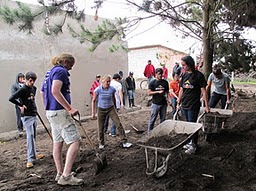
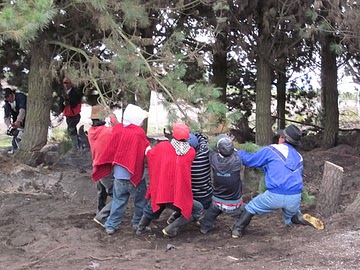 Today, I was placed on project duty. It consists of helping the locals of Pull San Pedro build a bathroom for their school. Surprisingly enough, we ended helping in other ways. Emily, Esther, Francois, Kate, Yang, Sonja and I were dropped off at Pull San Pedro while the rest of the MEDLIFE brigade moved onto the next village to set up the clinic. At first, we stood in the courtyard waiting for instructions and watching the village men wrestle down a few trees. The children were hiding in the entrance ways, giggling at us gringos. (Their teachers realized what a attraction we were for the kids and eventually let them come out and meet all of us.) We felt like parents at a Justin Bieber concert, taller than most and not completely sure what we are there for.
 After a few minutes, the women of the village started working on expanding the courtyard, using hoes and shovels to break the old field. It was then, through much miming, we managed to ask if we could help. I’m not sure if it was because they actually needed the extra hands, or because they just wanted to see strange foreigners have a go at manual labor, but they accepted our offer. I have the utmost respect for the villagers that we worked along with. Their tools were primitive, but had a certain simplicity to them. All the women worked in traditional Ecuadorian clothing (long skirts, a hat, several layers of sweaters and rain boots). I even saw one working the entire day with an infant strapped to her back. The general mood of the group was relaxed. There was no rush to finish, yet there were no breaks in the workflow.
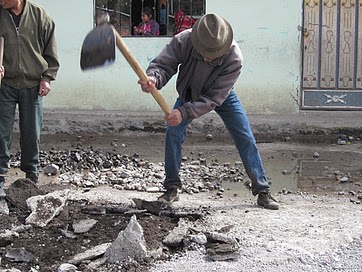 The first half of the day consisted of breaking down concrete, shoveling, making inappropriate hoe jokes and wheel-barrowing tons of dirt and rocks. These were unlikely tasks for a party of out of shape university students whose most recent idea of heavy lifting meant carrying a biology textbook to class and doing cardio meant climbing up to the fifth floor of the library. After a few hours, we heard the “gringo alarm” (a loud siren usually used to signal the start of the clinic), and the teachers invited us into their lounge and treated us to a local snack. It consisted of bread, boiled eggs and an amazing drink (soy, grains and many other nutritious ingredients). Yang was kind enough to teach us the fastest way to eat a boiled egg (ask him, if you´re interested). After our snack, we went back to work.
 The men were moving the remnants of the pine trees that were cut down earlier. We jumped right in to help; pine sap ended up everywhere. Once that was done, we moved onto extracting stones from a pile of dirt and subsequently used them as foundation for the soon to be larger courtyard. By 1300, the bus arrived to pick us up. We were saddened that we were unable to cover the entire courtyard in stone, but still satisfied by the amount of work accomplished during the course of the day. While the day was rewarding, I am very excited to head back to the clinic tomorrow, and more excited to see the new bathroom after the week is done.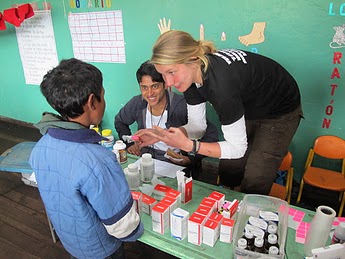



 medlifemcgill.com