How to Communicate

by Tiphaine Monroe

It got off to a bumpy start, but day two was definitely my most memorable. We all clambered into the bus at 7 and were off. The driver warned us that it would be a long ride, about an hour and a half full of twists and turns up steep mountains. The terrain was so difficult that on three separate occasions, we all had to get off the bus so that the driver could maneuver out of a ditch.
Once we arrived, we were greeted by a wonderful community. All the students were gathered in a courtyard to sing us a welcome song. Then the school’s principal gave us a moving speech about how little help their community had received before MEDLIFE and how he hoped that we as students and volunteers would never forget the plight of the poor.

My station that morning was vitals. I’ll admit that I was nervous at first. Although I studied Spanish throughout high school, it had been two years since I had spoken a word and my transition back into the language was shaky at best. For good measure, I wrote down the words ‘parese’ (step over here) and ‘saquese’ (remove) on my hand in case I forgot them for the hundredth time. That’s definitely a strategy I would recommend.

Vitals turned out to be my favorite experience. Our job was to greet the patients and get their height, weight, temperature, and blood pressure so that they were prepared to see a doctor. We had to be as quick and efficient as possible while still maintaining an atmosphere of caring and warmth. I loved all the hands-on experience with patients, asking all the kids what their names were, convincing them that the thermometer should stay under their tongues, and listening to them squeal with delight when they learned how to say ‘hello’ for the first time. One of the most challenging moments we had was trying to convince an 86-year-old, partially-deaf woman who spoke only Quechua to let us put pressure cuff on her arm – no simple task.

We switched after lunch, and I was assigned to the toothbrushing station. I loved handing out the tiger-themed brushes to all the kids and struggling to explain to them what fluoride was for. Once all the serious cleaning business was over, we still had time to talk to and get to know the kids. They told me about their school and the sports they like, when their birthdays were, and how many siblings they had. They tried (unsuccessfully) to teach me how to say hello in Quechua. Most of all, they were interested in knowing when we would come again and how long we would stay

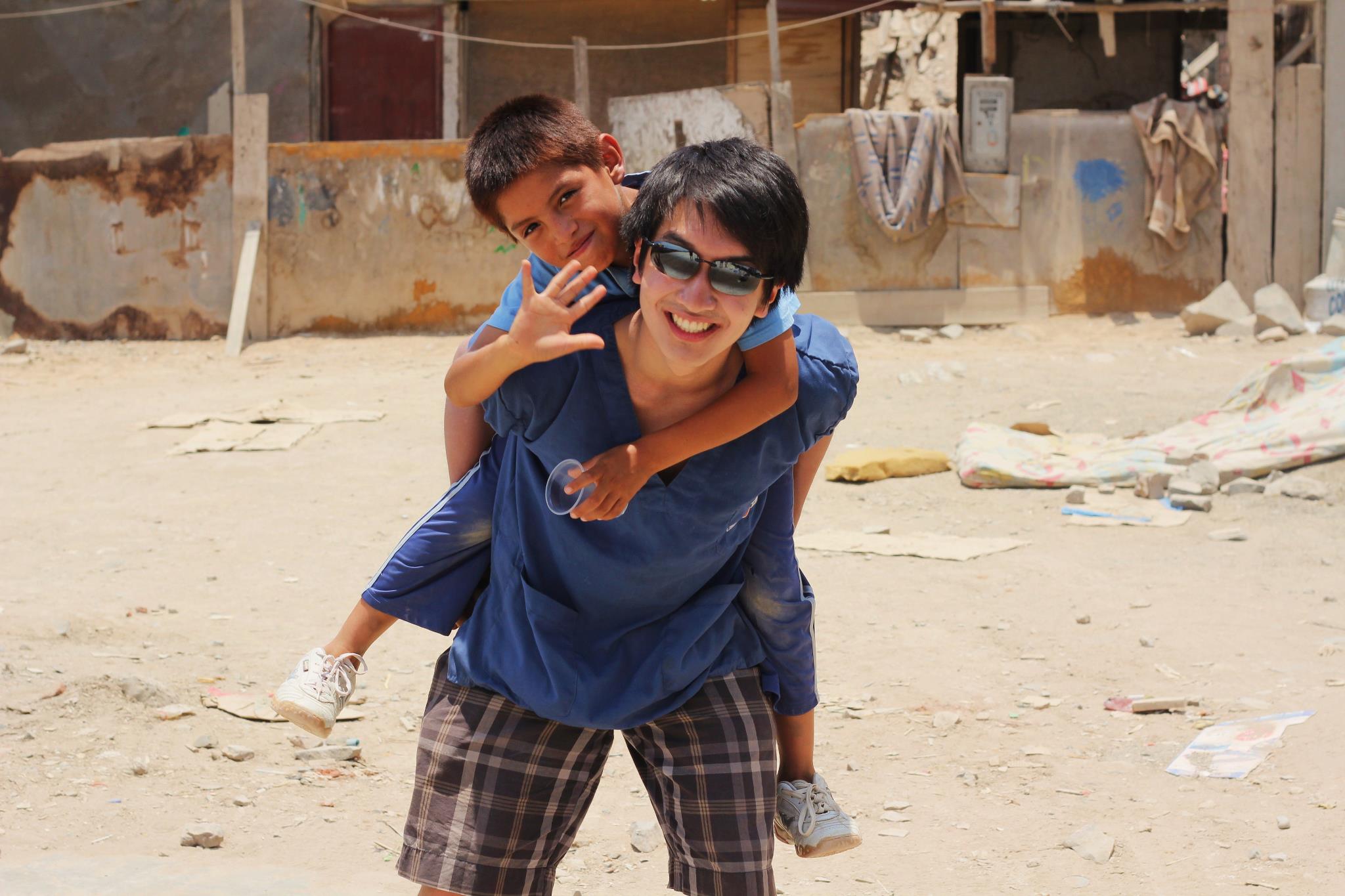
All of the kids were shy at first, but once I pulled out my notebook and asked them if they wanted to draw, all we saw were smiles. I now have several lovely pages covered in houses and llamas and flowers. My camera was also a big hit. Every time I took a portrait, they would race towards me so I could show it to them. I eventually taught a couple of the boys how to take a picture themselves and they immediately became snap-happy. They made a game out of chasing around the shy girls to get them in a picture. Before we left, the community thanked us and gave us boiled potatoes with sauces.

How to Build a Bathroom

by Danielle Bohonos

Besides providing Peruvian communities with medical care, one of the goals of the MEDLIFE organization (as we have learned during our daily meetings) is the development of the communities we serve. This brigade we have committed to building a bathroom for a school in one of the local towns outside of Cusco. Each day, a small group of volunteers has spent their day at the school wheeling sand and dirt up hills, digging holes, and mixing cement. Tuesday was my turn to visit the project.

Our main duties were to shovel a sand and rock mixture from a large pile at the base of the hill the school was on and then wheel that mixture up the hill to the entrance of the school. From their we made an assembly line and passed the mixture down to the actual location of the future bathroom (just outside the classroom) in buckets.

After what seemed like a hundred passes of the bucket, we were told we would have a break. Fortunately for us, and our hungry bellies, the teachers and adults of the school had cooked potatoes that they had grown in the town and served them to us with a green sauce filled with garlic, herbs, and more. The combination was delicious, and I can honestly say was one of the best potatoes I have ever had in my life! During our potato feast, the kids of the school were also eating lunch – a mixture of beans and rice.

As we finished the meal, we contemplated the rest of the assembly line work we had ahead of us – only to be told that we would now be heading to a farm to help plant corn! When we arrived the farmers were eating lunch, so our visit was limited to multiple death-defying pictures posing with bulls that were suggested by Carlos (the head of Peruvian Brigade prep if I understand correctly). Interestingly enough we were allowed to work with the bulls in tilling the soil for the crops; we followed behind a pair of bulls as they dragged a large wooden spike into the soil.

Finally, we finished the day wandering down an old Incan path, where many of us found chunks of pottery and small “treasures”.

How to Get a Tooth Pulled in Cusco

by Danielle Bohonos

6 am is quite the wake up for a group of travel weary MEDLIFE volunteers, as most were still acclimating to the extreme elevation of Cusco, Peru.  Copious mugs of coca tea were just what the doctor ordered. Due to the large size of the Cusco Brigade, our body of volunteers was split in two, allowing us to visit multiple communities in one day. Group 1 headed into the mountains outside of Cusco into a small community essentially made of mud-brick houses, fields, crops, and a school – or at least that is what it appeared to be. We set up the clinic at the nicest building in the community – the school. As we carried boxes of medical supplies and gear into the school walls, we were quickly surrounded by ooo-ing and aww-ing school children who seemed to just appear from cracks in the walls!

Vitals and Dentistry were the two stations I was charged with for the day. Vitals, which includes taking the patients temperature, height, weight, and blood pressure, was quite the pressure-loaded event for a Spanish-deficient volunteer like myself. After learning the phrase for “stand here,” I was able to successfully measure each patient with relatively little difficulty – thank goodness our supervisor Alberto took pity on me enough to phonetically teach me the phrase! Vitals, despite being relatively repetitive, was one of the most exciting stations to be at because we were lucky enough to interact with everyone who entered the clinic, whereas others only saw patients with specific problems.

The dentist, I understand now, is one of the most incredibly important services that MEDLIFE can offer these communities; with a lack of money and the urgency of simply completing a family’s daily tasks, teeth cleaning and the supplies needed for this get forgotten. Almost every child who entered the facility had rotten teeth that were black to the core, or teeth that had grown in to the wrong spot. The dentist explained to us during her examinations that these kids cant afford to pay for braces or dental work in general; the majority of the children all needed these teeth pulled or filled . One remarkable nine year old girl sat in the dentist’s chair and was told she needed an infected tooth pulled.  She agreed to it and didn’t whimper at all as the dentist numbed her mouth and then extracted the tooth. She was the only child who agreed to take the care the dentist offered her.

Overall, the first day of clinics was extremely eye opening, and it is already quite evident what great work that MEDLIFE does for these communities.

*Pictures to come!*

How to Start an Adventure: Machu Picchu

Tourists travel to Cusco, Peru throughout the year to experience the astounding history, culture, and environment that this city has to offer. However, over the course of the next 11 days, some MEDLIFE McGill students will have the opportunity to not only travel to Peru, but to give back to this community during the MEDLIFE Cusco Brigade this month.
 
by Danielle Bohonos

Six of us arrived in Peru early, braving the threat of altitude sickness, mosquito bites, and extremely sore muscles on the 5 day Salkantay Trek to the lost Incan city of Machu Picchu. The trek took us through what seemed like every possible terrain from rocky mountainsides to blazing hot jungles culminating in what I’m sure each of us would regard as one of the most memorable weeks of our lives.

The trek began with breakfast in the small town of Mollepata Peru with our guide Freddy, who we quickly concluded must have had a different understanding of time, because every “20 minutes more” was guaranteed to be longer than 20 minutes. This proved to be the hardest day of the trek, as after lunch we were forced to climb nearly 3 hours in frigid wind to the first camp site; at over 4000 meters elevation that made for a bone-chilling first nights sleep! However, the lengthy climb paid off the following morning when we reached the peak of the Apachata Pass at nearly 4600 meters high! There, our guide instructed us in making a rock pillar offering to the mountain and showed us how to use coco leaves, make a wish, and “flow” to the mountain. From that point on, it was downhill into the jungle, to warmer temperatures and smack into the capital of mosquito central!

If the second day’s downhill terrain wasn’t nice enough, the hot springs we visited on our third day was definitely a relief for our sore muscles. The fourth day ended our seemingly non-stop walking through the jungles of Peru and ended at the town of Aguas Calientes at the base of the Machu Picchu Mountain. After a night on the town and a sweet sleep at a hostel, we rode the bus to Machu Picchu on the fifth day where we feasted our eyes upon the incredible engineering, history, and beauty that is Machu Picchu. Freddy guided us around the city, explaining the significance of the Temple of the Sun, the famous Incan stonework, and more. A few hundred pictures later, we took our leave of the ancient city descending from the mountains and headed back to Cusco anticipating relaxation, sleep and the MEDLIFE Clinics to come.

Aftermath Feelings and Thoughts!

Aftermath Feelings and Thoughts!


As the March 2012 Brigade pulled to an end, the MedlifeMcGill Brigade returned home to Montreal. Tired but Satisfied, all they wish for is to share their emotions and stories with family and friends. Here is what some had to say!

A recap some of the students’ favorite moments from their week with MEDLIFE. From heart-warming moments to chuckle-worthy memories, here’s what some students had to say

“My most moving moment was during my afternoon dentist rotation at Manchay on the fourth day. Claudio and his team of eager, but sleep-deprived helpers were operating on a 9 year old boy named Ronald. I had previously met him at the toothbrushing station in the morning and he was among the very few with rows of clean teeth. The reason that he was also at the dentist was because he had a fang jutting out above the gumline. In North America, this problem would be ameliorated with braces, but here, in the slums of Manchay, one does not have the time or the resources for visits to the orthodontist. The more straightforward solution was to simply yank the fang out. As the anesthesia was applied, Ronald shifted uneasily in his chair. Claudio told us to hold onto his hands to prevent him from trashing around during the operation. I gave him my hand for support and felt a tight grasp as Claudio forcibly broke the fang into pieces and removed them. I remembered my operation when I got my premolars removed, during which I cried like a baby. I was 12. Ronald, this 9 year old boy from Manchay, shed not a single tear or even complained. This moment really stuck with me because it is a reminder that our problems pale in comparison with theirs. We complain about our internet speed in rez; they risk their lives to obtain electricity. We howl in agony after we get our braces tightened; they are grateful to even have a visit from the dentist. The Peruvians really do live in a completely different world from ours, and it was only living and experiencing this world first hand these last 5 days that I have been able to fully realize that. I will never forget the Peruvians’ hardships and appreciation, as well as Ronald’s bravery. Thank you Medlife Brigade ’12 for showing me this :)”

– Dantong Jia

“This may not be my favourite memory from this trip but definitely one of the funniest. I was helping at the toothbrushing station on Day 2, and trying my best to communicate with the children and parents in Spanish. I had asked someone for help on how to say “return the cups” and was told it was “devuelve el vaso”. The only problem was, I misheard it to be “devuelve el beso” which means “return the kisses”! No wonder all the parents and children snickered every time I said it. I, of course, did not find out til hours later the silly mistake I was making.”

– Taiji Wang

“First, some background in Spanish. “Me llamo” = “My name is”. “Te amo” = “I love you” at the highest level of love, for your significant other for example.Someone (whom I will let introduce themselves) wasn’t quite pronouncing the “y” sound in “llamo”, so it came out as “me amo [name]”, which means “I love myself (a lot), [name]”. Not quite what was intended :)”

– Kim Apperley

“One of my best was when Claudio said I played soccer like a Peruvian boy.”

– Heather Johnson

Celebration Time in Pamplona!


Final Clinic Day!

Celebration Time in Pamplona!

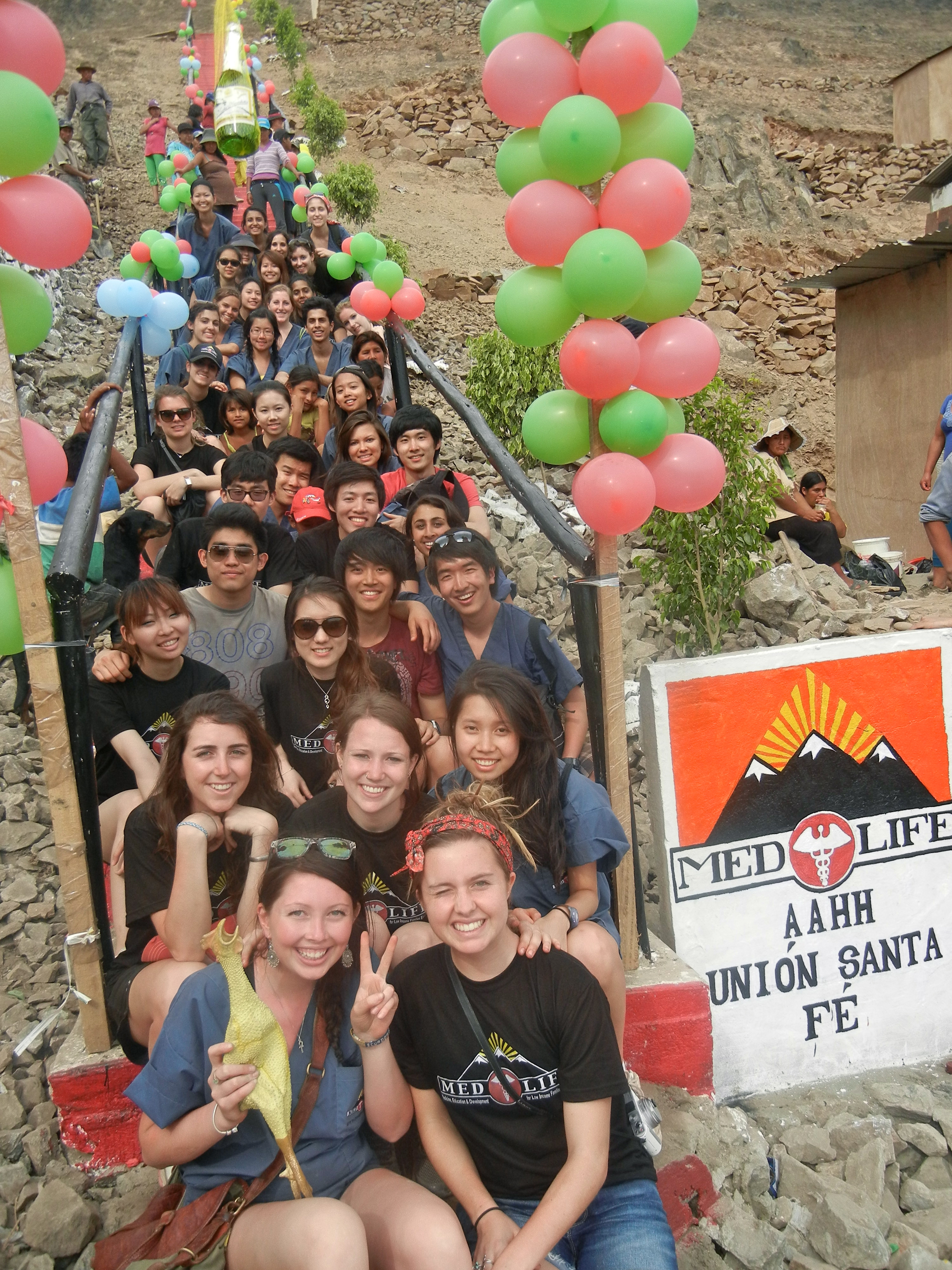
On our fifth day of the mobile clinic we went to Pamplona, which is one of the largest slums in the Lima area. Pamplona is also the neighbourhood where we have been building stairs all week. In total, our team managed to build two entire staircases. Another 150 patients were provided with medical services today putting our grand total to approximately 1400 people helped this week alone.

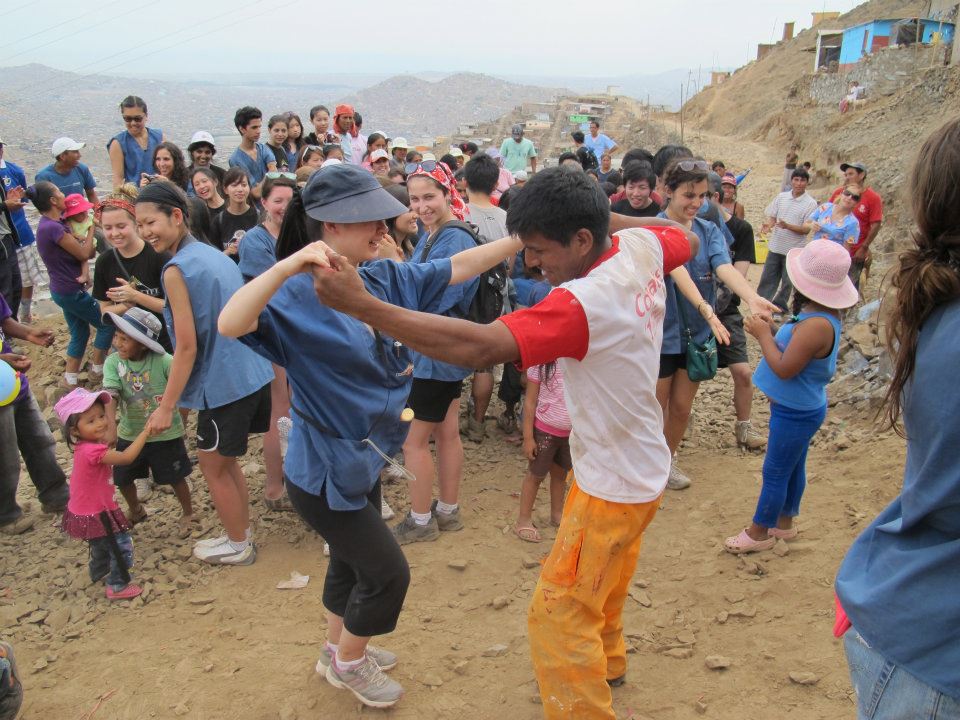
The end of the day was a huge a celebration as we held the official inaugurations for the two stair cases built by our McGill brigade. When we arrived, the stair cases were painted the signature MEDLIFE red and decorated with balloons and streamers everywhere. Community members greeted us with smiles, Inka Cola, and crackers. The area was filled with music and dancing as we celebrated our “muy grande” accomplishment.


The village leaders gave heartfelt messages of thanks and appreciation to everyone involved conveyed by our very kind translators. The common message from all of the people of Pamplona was one of optimism for future generations and of awareness of the world that exists outside our own comfortable lives. One man talked about fate and how we were meant to be there to help them and realize the conditions that these people live in. He expressed sincere hope that we would never forget them and the lives they lead. Other community members wanted to ensure that they could continue to count on MEDLIFE to help their neighbours and friends in the future. There is still much to be done but every little bit really does make a world of difference for them.

A few volunteers got the chance to give their take on their experiences over the past week. The stairs were a huge highlight as most of us have never been able to take part in something that is so permanent and life-changing for another human being let alone so many. Going back to see the finished project we all could look at the stairs and know that we were a part of that. It was truly wonderful.

Gracias to all of the communities that allowed us into their lives. We certainly never will forget you.

Hasta que nos encontremos de nuevo.

Until we meet again.

MedlifeMcGill